![PostPic_01[2] kopie](https://habitofimprovement.com/wp-content/uploads/2014/03/postpic_012-kopie.png)
Due to globalization and corporate conversations adapting from top down one direction broadcasting to collaborative multi-way inclusion, the need for platforms has grown. Employees become engaged in a new social thinking strategy to create a sustainable climate for personal and corporate growth.
Corporate intranets where first introduced in the 90s and are at this point in 2014 a normal but rather old medium. A closer look at what intranets were and are becoming will reveal that not only the medium has undergone a considerable evolution. but also the way employees and decision makers work. Companies now use the knowledge within their organization to the full extend. It is about using al the knowledge in a company, monitor conversations and listen to stakeholders in an era were big data is the buzz and nobody is really listening anymore.
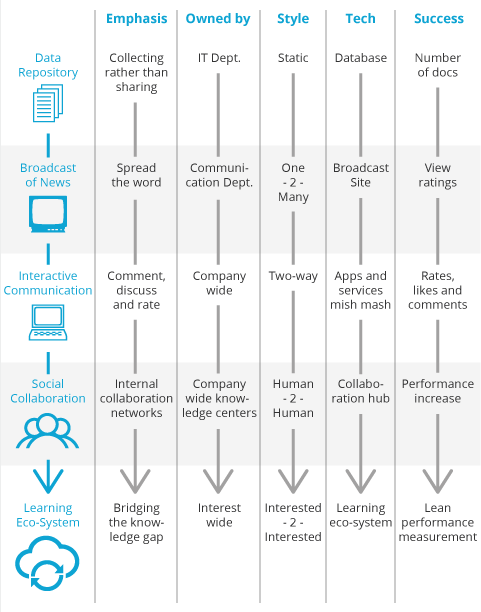
Going back to the 90s and looking at the evolution the first intranets have gone through we see a trend towards greater interactivity and collaboration in four stages. As you read this article you can map were your organization would fit and were your future development could focus on.
1. Data Repository
In its initial form we could state that shared databases would be the first intranets. Protected by firewalls, a collection of documents is made accessible for members of the same organization or community. Those content management systems are maintained by administrators (IT department) and currently still in many occasions hosted on corporate servers. They are static content focusses and data is more important than the conversation or the sharing of knowledge.
2. Broadcast of News
In the next stage we see companies looking for ways to get their employees engaged around data. This is the time were leaders feel that employees want to be involved in decision making and want to hear internal news directly and not via public media channels.
Sets of messages are broadcasted through internal channels. Communication Managers get a significant role within organizations. They need to get the strategy and mission of the company out to all people involved. The message is sent but is the message understood?
3. Interactive Communications
The crucial step in all organizations and in the evolution of intranets establishes itself when all employees can engage directly with both site content and corporate conversations without being part of a silo like the IT Department or Internal Communications.
This is when the intranet and the organisation take the social path. Users get the chance to share, rate and even comment on blogs, being part of corporate strategy and internal communications. They become part of the decision-making unit of the company, are internal communicators and replace IT administration, silos start disappearing.
Platform wise we see that content management systems are linked to chatters, broadcast sites get social features, discussion forums are created, … Silos are disappearing within the organization. However, new tools and platforms are being created to answer all new needs, many times with overlaps in functionalities.
4. Social Collaboration
In this stage the intranet relinquishes its primary identity as a place from which information is retrieved to a place to collaborate with people.
This stage is even more influenced by the popularity of social network sites like Facebook and LinkedIn. Social organizations are reinventing their intranets to become internal professional collaborations networks. The function of the intranet has changed to a place to find information and getting things done together. Content management systems, chatters, and social collaboration tools are flourishing in companies all trying to improve corporate conversation and social collaboration, however the risk of those tools is that again there is to much and employees lose track of the benefits for themselves and don’t use the tools for their purpose of social collaboration.
New intranet platforms offer integration with existing tools and are placed as a hub over existing tools, combining the strengths of each of those for its best purpose. Discussion forums, chatters, blogs, micro-blogs and files are all integrated and become one system. In this stage the most valuable asset is no more content,but the people and their personalized detailed profiles. People put a face on conversations and make them personal. “Human-2-Human” (2014, Bryan Kramer).
Hierarchic barriers start disappearing and people share news, best practices and even fun stuff like they do around the coffee machine. A community emerges and is all about belonging, sharing and co-creation in one platform. Social collaboration will not stop within the organization’s intranet but will include partners and customers. “Social Selling vs. Social Collaboration” (2014, Katja Schipperheijn).
5.Will the future bridge the knowledge gap?
So we have a community and people collaborate what could we improve? In recent years many studies have been made around the knowledge gap in organizations, for example “The use of social networks methodology for detecting, connecting and facilitating informal networked learning in organizations”. (2011,Maarten de Laat)
The successful transfer of knowledge between organizational units is critical for a number of organizational processes and performance outcomes. Organizations should strive to distribute knowledge within their organizations using an internal social and learning eco-system. Learnscapes bridging (regional)departments, corporate hierarchy and formal roles with one purpose: the flow of knowledge through the organization.
In my next Blog I will elaborate the knowledge gap within organizations, informal learning initiatives and some attempts to build social an informal learning platforms
A last note, any corporation, big or small can only be as collaborative as its culture allows! Don’t rush to move your intranet to a Social Collaboration site or Learning-Ecosystem if you are still in stage one.


2 thoughts on “From Data Repository to Social Collaboration and Bridging the Knowledge Gap”
Comments are closed.